
Searching St. Clair County Criminal Dockets
State criminal cases in St. Clair County live with the Circuit Clerk of St. Clair County. For remote access, Alabama offers two paid options. One is an Alacourt.com subscription. The other is the Just One Look case-by-case service linked by the Alabama Administrative Office of Courts. Neither fully replaces the clerk's office. Staff can tell you the right office. They know whether Ashville or Pell City holds your file, and they can show you how to read the electronic docket for free during regular hours and quote a copy fee.
Start with a case number if you have one. Without it, a paid name search can turn up a matching public state case. Then take these steps for a thorough criminal docket search:
- Decide whether the charge is a Circuit felony, District misdemeanor or preliminary felony matter, state traffic case, or municipal offense.
- Check the notice or citation for the Ashville or Pell City division and preserve all punctuation in the case identifier.
- Start from the Alabama AOC gateway and choose its official trial-record access route.
- Match the court, case ID, charge, parties, status, and judge before reading the Short Docket from oldest to newest.
- Call or visit the Circuit Clerk when a match is uncertain, a case is older, or a certified judgment is needed.
St. Clair Criminal Docket Court Split
Which court holds the docket depends on the offense level. Felony prosecutions move to St. Clair County Circuit Court once a grand jury indicts. St. Clair County District Court takes misdemeanors. It also handles the early stages of felony cases and state traffic matters. Each municipal court keeps its own ordinance, misdemeanor, and city traffic cases. A charge filed by a city court will not show up on the Circuit Clerk's state docket. Sitting inside St. Clair County does not change that. City cases stay city cases.
| Court | Criminal docket work | Custodian |
|---|---|---|
| Circuit Court | Indicted felonies and other Circuit matters | St. Clair County Circuit Clerk |
| District Court | Misdemeanors, early felony steps, state traffic | St. Clair County Circuit Clerk |
| Municipal court | City ordinances and municipal traffic | Issuing city's municipal clerk |
Knowing that split saves searchers from a common dead end. Before paying for remote access, ask which agency issued the charge and which court name is printed on the notice.
Reading St. Clair Criminal Docket Terms
Alabama's courts call the chronological event list the Short Docket. It works alongside the case header. The two do different jobs. The header names the court, location, and case type. It adds the case ID, description, filing date, security level, status, and judge. The Short Docket then puts a date on every filing and court action. Other tabs you may see include Party, Demographic, Limited Event, Violation, Arrest, and Traffic Detail.
- Arraignment
- The appearance at which a formal charge and plea are addressed.
- Continuance or reset
- An entry moving an event; the old date remains in the history.
- Disposition
- The recorded outcome or end status of the case.
- Nolle prosequi
- A charge ended without the requested conviction, subject to the exact order and procedure.
- Image indicator
- A marker that an electronic file is attached, not a promise that the image is public or free.
Inside a St. Clair County Criminal Docket
Read a St. Clair County criminal docket as a sequence, never as a single label. Confirm the court and location first. After that, weigh the charge against the later events, settings, pleas, orders, and disposition. A pending status shows where the case stands. It only covers right now. It proves no guilt. An arrest record is a different animal from the criminal court docket itself.
| Case identity | Court type, location, case ID, case description, and security level. |
|---|---|
| Charge or violation | The accusation placed before the court and related violation detail when available. |
| Settings | Initial appearance, preliminary hearing, arraignment, motion, plea, trial, or sentencing dates. |
| Actions | Filed motions, notices, judicial orders, and other chronological events. |
| Outcome | Plea, trial result, dismissal, sentence, financial information, and appeal activity as applicable. |
Need the full filing text? Open an available image through the authorized service, or ask the Circuit Clerk for the document. A docket line is only an index and summary, not a certified copy of the order.
St. Clair Criminal Docket Resets
Criminal settings from months ago stay visible. They linger even after a case moves on. That history is useful. It can still trick a reader into missing a court date. Begin with the newest entry that actually sets an arraignment, plea, motion, trial, or sentencing. Then read every later entry for a continuance, amended order, cancellation, or fresh notice. If two official notices conflict, call the assigned court. Do not just pick the date you like better.
Setting check: The newest clear setting controls only if no later court entry changes it. Confirm uncertain St. Clair County criminal docket dates with the assigned clerk.
How a Criminal Case Moves
A felony often starts with District Court activity before an indictment shifts it onto the Circuit criminal docket. Misdemeanors usually stay put in District Court. A municipal charge stays with the city unless an appeal or another authorized transfer moves it. That movement leaves marks on the docket. Look for a new case number. An indictment, a transfer order, or a notice of appeal can mark it too. Keep both the old and new numbers handy.
Docket flow: Filing › Arraignment › Pretrial › Plea or Trial › Disposition › Sentencing
Cases skip steps all the time. Preliminary felony proceedings, motion hearings, docket calls, and review settings can sit between the main stages. Whatever else appears, the final judgment or sentencing order controls.
St. Clair Docket Outcome Checks
A charge is only an allegation. An arrest is only an enforcement event. Neither one is a disposition. On a St. Clair County criminal docket, the real outcome arrives later through entries like dismissal, nolle prosequi, plea, trial result, judgment, or sentence. If a remote screen stops at an early event, check the most recent status and the underlying order before concluding anything.
Money entries need context too. Costs and balances can belong to a criminal case. Yet a payment portal is not the whole docket. The Alabama Traffic Service Center and AlaPay cover eligible state traffic matters. For a nontraffic criminal case, they will not give you the full chronology.
St. Clair Criminal Docket Images
The official St. Clair County criminal division page lists the local criminal court channel and contacts.
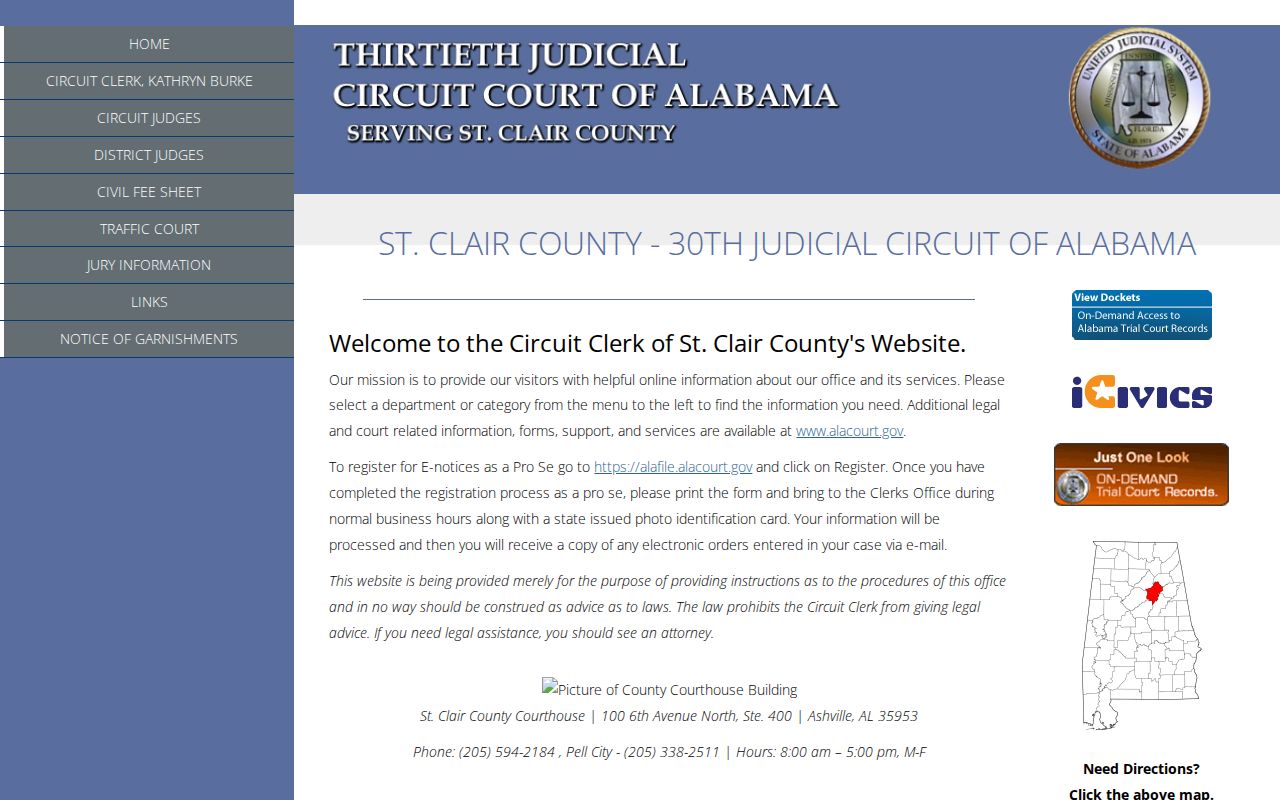
State criminal docket questions belong with the local Circuit Clerk's criminal division. They do not belong with an unrelated arrest database.
Alacourt flags an attached filing with an image indicator. Pulling document images remotely costs extra, and confidential images stay withheld. When no image is available, ask the clerk whether you can view it at the proper St. Clair County counter. Also ask how to order a plain or certified copy.
Courts That Hold Criminal Dockets
Two courthouses divide St. Clair County's criminal docket work. The Circuit Clerk runs full-service offices in Ashville and Pell City. Both hold Circuit and District records. Ashville sits at 100 6th Avenue North, Suite 400, Ashville, AL 35953, phone 205-594-2184. Pell City sits at 1815 Cogswell Avenue, Pell City, AL 35125, phone 205-338-2511. Doors open at 8:00 a.m. and close at 5:00 p.m. on weekdays.
A call ahead saves time. Staff can confirm the right division. They can also confirm the latest court date, whether an older case is on hand, and what copies cost today. Walk-in visitors get free viewing of public electronic Circuit and District dockets during business hours under Alabama's current court-record rules. Mail requests work too. But phone first to confirm the exact record, the quoted price, the accepted payment method, and the return-envelope instructions. On the day of a hearing, the docket posted at the courthouse tells you the courtroom after security.
St. Clair Certified Criminal Orders
Tracking events on a screen is one thing. A certified judgment or sentencing order is another, and only the Circuit Clerk issues it. Your written request should name the court, division, case number, case style, and the specific document. It should also list the approximate filing date, the number of copies, how you want it delivered, and how to reach you.
The clerk's published pages list no fixed plain-copy, certification, exemplification, or search fee. So call for a current quote before mailing funds. Older or non-imaged court records may need staff retrieval. Ask whether the file is electronic. Ask too whether public counter viewing is offered, and whether identification or court authority is required for restricted material.
St. Clair Criminal Docket Limits
Juvenile records stay confidential under Alabama Code section 12-15-133. Youthful Offender, sealed, and other protected matters may be missing. They may also be limited in a St. Clair County court docket. When a public result is absent, the cause could be the wrong court, the wrong division, an older record, a spelling issue, or a confidentiality rule. It does not prove no proceeding exists.
The Alabama Court-Record Privacy and Confidentiality Rules, effective January 1, 2025, govern free viewing at the clerk's office. They also define protected categories. Rule 33 covers AOC electronic databases and remote access separately. Confidential case details and images never come through Alacourt. Access beyond the public record requires legal authority or a court order.
Sealed Dockets and Public Access
Ordinary St. Clair County criminal dockets stay open to the public. You can inspect them through the paid remote service. You can also view them free at the Circuit Clerk's office during regular hours, though copies, certification, and remote images are separate products. A sealed docket is different. It is not deleted. Access is blocked unless a rule, statute, or court order allows it.
Key rules:
Alabama Court-Record Privacy and Confidentiality Rules set the current public-viewing, confidentiality, and sealing framework.
Rule 33 of the Alabama Rules of Judicial Administration governs access to AOC electronic court databases.
Alabama Code section 12-15-133 protects juvenile legal and social records, subject to statutory exceptions.
If you hold legal authority to see restricted material, contact the court that keeps the case. Counter staff cannot waive a seal or confidentiality rule for anyone.